
Wild boar have a fierce reputation, I assume from hunters tales of bravado as in all the 6 years I spent living in the forests of Portugal with them I have only seen them running away from me. And I’m not very scary!
It’s a long time since I lived there, but about 6 years ago, we started leaving camera traps up in the woods, only catching up with the images they collected months later, and this is how we discovered we had badgers, and otters but that’s a story for another time, The wild boar we caught on these cameras offered me a completely different insight. Each time we returned to Portugal, I would open up these camera boxes of visual treats and learn something new.
In the short video above, is a typical first reaction, here they are seen curiously examining the camera, and rather than catching the blur of an animal running away from me at speed, I can see a cautious but curious creature with large ‘bear-like’ ears and long lashed eyes, her long snout wetly snuffling at the camera, before she carries on going about her business.
And this was all new to me, in spite of the many very obvious signs of their inhabitance of the cork forest – with huge wallows and mud covered tree trunks where they have rubbed their backs, and the churning of the soil of abandoned olive groves all around. These nocturnal creatures are barely visible by day, it is surprising how well hidden such big beasts as these are in the daytime – where they sleep, I gather, in nests with their young or behind the windbreaks they create.
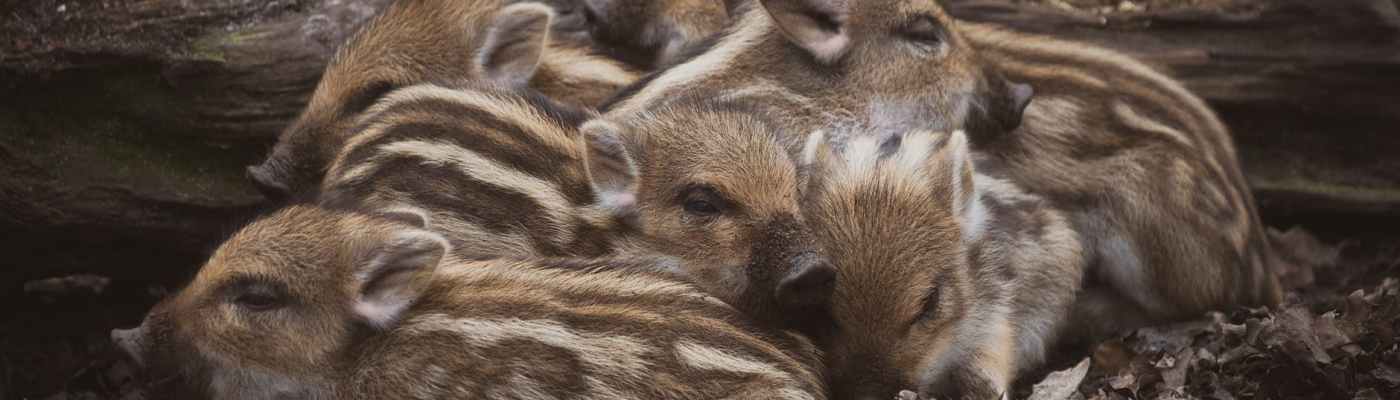
It is this insight, that has made me seek out further information on them, and there is surprisingly little. It is often the case we only study something once it is rare, and that perhaps explains the lack of literature or documentaries dedicated to Sus Scrofa – wild boar. Because it isn’t that they don’t have cute young – their fabulously cute striped russet piglets outshine many baby mammals – and they have the appropriately cute nickname ‘humbugs’ as a result.
I would love to read more about their social life, range, role in the eco system, but I can find very little. I find it really interesting to read of the similarity to another big disruptive creature – the elephant. Apparently the largest males can, like elephants, have a couple of younger males as companions. And the females – very sensibly – pool their piglets, and share the care of their humbugs. Two to four sows form ‘sounders’, and one sow may take care of all of the piglets from time to time.
It may be this ‘creche’ that has led to myths about their prolific breeding – because the occasional sighting of a sow with numerous piglets can be misleading, more than 5 are highly unlikely to be the litter of one sow, and are much more likely to be the collective piglets of more than one sow. Wild boar generally breed just once a year and have 2-5 piglets.
In Britain, their previous extinction has left them with next to no protection and they are classed as feral. There is no ‘closed season’ for hunting wild boar. And shooting is their most likely cause of death – some 80% of wild boar monitored by Defra died this way most before they reach even 2 years old according to the 2008 Defra report.
My internet searches revealed a huge disparity in estimated numbers too, there is an estimated number of between 500-4,000 wild boar living and breeding in Britain, which shows a shocking lack of information on these native mammals. Data collected about other wild mammals in Britain doesn’t cover wild boar, though other wild mammal data and trends are also surpisingly sparse, the citizen based approach of the British ornithonological surveys which started including mammals in 1995.
Defra has spent over a million pounds researching them so you would expect there to be more information than there is, their reports have covered human-wildlife conflict, DNA sampling and even tracking of wild boar.
Most of the current wild population in Britain is from farmed wild boar escapes, starting in the 90’s. The largest population is in the Forest of Dean, and here they have grown a following of humans who are looking out for them, spreading awareness, and countering ignorance and disinformation.
The Forestry Commision has since 2015, meanwhile culled 4-500 Forest of Dean wild boar annually, selling them to game dealers, the numbers culled are somewhere between a third to half of the estimated population. In 2018 and 2019 they have issued census reports of ‘feral’ wild boar populations which show a decline in this population. The friends of the wild boar have their work cut out.
Sightings of wild boar continue all over Britain, so they would seem to be capable of re-establishing themselves in Britain, but this depends on our attitude to them, not least because we Brits have wiped them out before and poaching is now on the rise, their future status remains uncertain. The lack of a closed season is indicative of this. It seems bizaare that there are debates on them damaging bluebells – but almost anyone with a firearm license can shoot one at any time of year, regardless of whether their are ‘humbugs’ in tow. These escapees need more allies and a more certain legal definition as a species if they are to flourish in Britain.
The wild boar across Europe and in the Portuguese cork forests are firmly part of the landscape and I look forward to what my next set of camera trap footage will reveal of their nature and social lives.
 Siobhan Mitchell